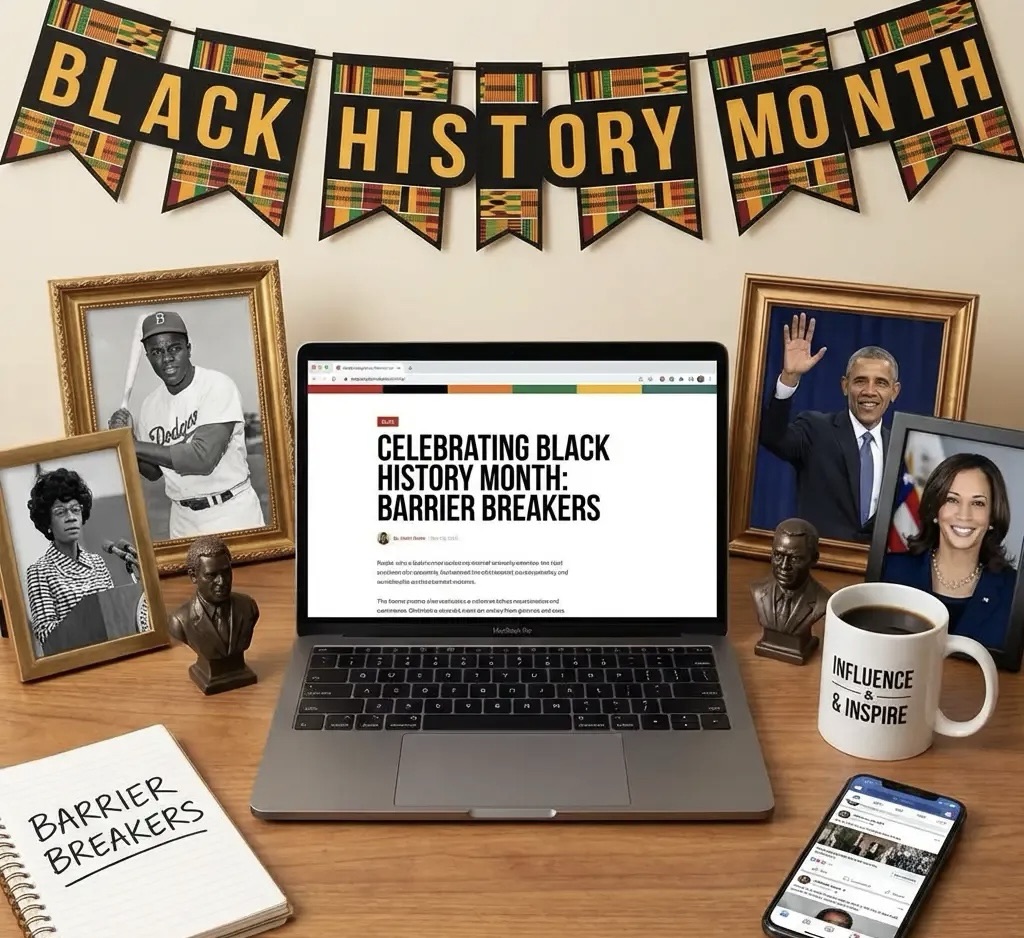
February arrives every year with the same familiar energy: tributes, quotes, school projects, social media posts. Black History Month often feels like a highlight reel with the best speeches, the bravest marches, the most inspiring quotes.
But Black history is not just the polished moments we like to share.
It’s also the uncomfortable parts we’d rather forget.
And this year, I’ve been thinking about that more than ever.
Because history doesn’t just live in museums.
It’s a reflection of all of us today.
Black history is filled with people who changed the course of the world.
Harriet Tubman, who risked her life again and again to free enslaved people, leading dozens to freedom through the Underground Railroad. She didn’t just believe in liberation, she acted on it.
Frederick Douglass, born enslaved, who taught himself to read and became one of the most powerful voices against slavery, challenging America to confront its hypocrisy.
Martin Luther King Jr., whose words still echo across generations, not just as a dreamer but as a strategist who believed justice required action, sacrifice, and uncomfortable conversations.
Rosa Parks, often reduced to a quiet woman who refused to stand, was actually a trained activist who understood the power of organized resistance.
Malcolm X, who forced America to confront issues of power, identity, and self-determination in ways that made people uncomfortable, but also impossible to ignore.
And beyond the famous names, there were thousands of teachers, domestic workers, veterans, business owners, artists, and parents who built communities in the face of systems designed to crush them.
Black history is not a side story.
It is American history.
But if Black History Month only celebrates heroes, we miss the point.
Because the truth is: America built entire systems on keeping Black people excluded, controlled, and disposable.
Jim Crow laws weren’t just about water fountains and bus seats. They controlled where Black people could live, work, vote, learn, and exist.
There were “sundown towns” where Black people were warned to leave before nightfall or face violence.
There were redlining policies that denied Black families mortgages and trapped them in underfunded neighborhoods.
There were poll taxes and literacy tests designed specifically to keep Black voters away from the ballot box.
There were lynchings that went unpunished, terrorizing communities into silence.
This wasn’t ancient history.
Many people alive today grew up under these systems.
And these policies didn’t just disappear but instead they shaped wealth, education, health, and opportunity in ways we’re still dealing with.
It’s tempting to believe that we’re so far removed from that past that it could never happen again.
But history rarely repeats itself in the same outfit.
It just changes the language.
Instead of “Whites Only,” we get policies that disproportionately harm certain communities.
Instead of literacy tests, we get barriers that make voting harder.
Instead of redlining maps, we get algorithms and zoning laws that quietly reinforce inequality.
The lesson of Black history isn’t just that people fought injustice.
It’s that injustice is persistent, adaptable, and patient.
Some people ask, “Why do we still need Black History Month?” Or, “why did we need it in the first place?”
Because forgetting is convenient.
Because celebrating progress without remembering the cost makes it easy to undo it.
Because democracy only works when people understand how fragile it is.
Black history teaches us what happens when people are stripped of rights, dignity, and voice and how hard it is to get them back.
It also teaches us what happens when ordinary people refuse to accept that reality.
Growing up, Black history felt like something that happened in black-and-white photos. But the older I get, the more I realize how close it really is.
My parents’ generation lived through segregation.
My grandparents’ generation lived through laws that openly treated them as second-class citizens.
And I live in a generation where progress is real but never guaranteed.
Black history isn’t distant. It’s inherited.
And inheritance comes with responsibility.
Here’s the uncomfortable truth:
History repeats when people think it can’t.
When people become numb to injustice.
When people believe rights are permanent instead of protected.
When people stop paying attention.
The past shows us how quickly fear can be turned into policy, how easily propaganda can shape public opinion, and how silence can be as powerful as violence.
Black History Month isn’t just about honoring heroes.
It reminds me that progress is built by people who were told change was impossible.
It’s about recognizing warning signs.
So for me, Black History Month is not just pride but also it’s perspective.
It reminds me that ordinary citizens can shift history.
It reminds me that the systems we inherit are shaped by choices and can be reshaped by new ones. It also reminds me that history isn’t over. We are writing it right now.
If there’s one thing Black history teaches us, it’s this:
Democracy, justice, and equality are not self-sustaining.
They require memory.
They require participation.
They require courage.
This month, I’m not just celebrating the past.
I’m thinking about what kind of history we’re creating and whether future generations will thank us or question us.
Because Black history isn’t just something to honor.
It’s something to learn from, before we find ourselves repeating it.
Discover more from What Grace Looks Like
Subscribe to get the latest posts sent to your email.



Leave a Reply