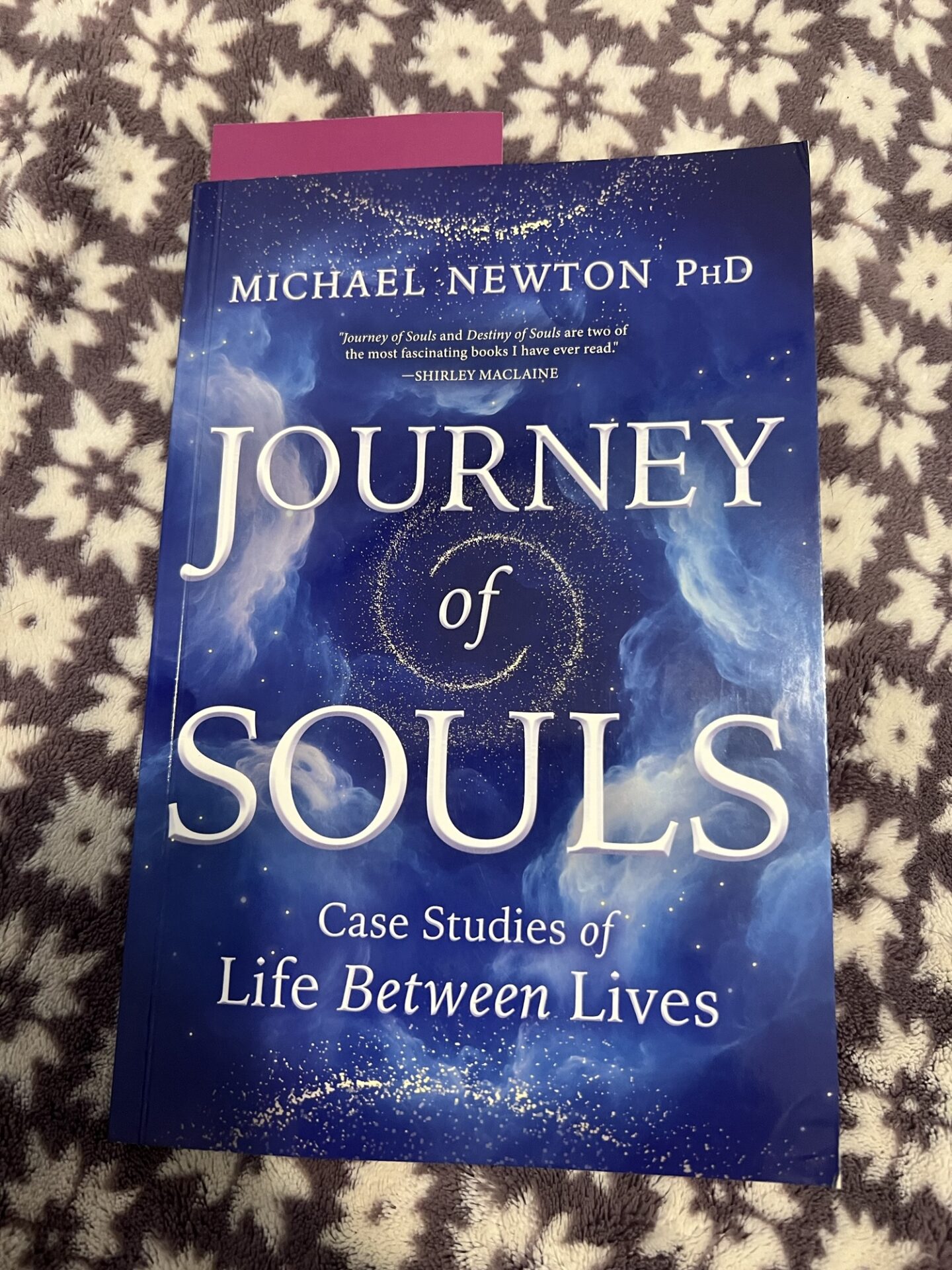
I picked up Michael Newton’s Journey of Souls because the subject immediately interested me. What happens after we die is one of those questions human beings have probably been asking for as long as we have understood that death exists. Even as a Christian who already has beliefs about death, heaven, and eternal life, I still find the subject fascinating. Faith doesn’t necessarily erase curiosity. At least it hasn’t for me.
Journey of Souls is not a Christian book, and I knew that going into it. Michael Newton was a hypnotherapist who wrote about clients he said were able to recall experiences from previous lives and, more importantly, what happened to them between those lives. Through hypnosis, his subjects describe leaving their bodies after death, entering a spiritual realm, meeting guides, reconnecting with groups of souls, reviewing the lives they had just lived, and eventually preparing to be born again.
It is a fascinating idea, and I can understand why the book has attracted so many readers. Newton doesn’t present the afterlife as something chaotic or frightening. The world described by his subjects has structure and purpose. Souls are supposedly learning, developing, and moving through different stages. Life on Earth is presented almost like a classroom where souls experience situations that help them grow before returning to the spiritual world.
There were parts of the book that made me stop and think, even though I don’t accept its conclusions. That distinction is important. I can find an idea interesting without believing it is true. I can also understand why someone finds an idea comforting without accepting it as part of my own faith.
In fact, I think that is one reason I enjoyed thinking about this book as much as I did. It forced me to separate those things.
There is something comforting about Newton’s description of death. In his account, death isn’t really an ending. The soul simply leaves one existence and returns to another realm. Loved ones may be encountered again, souls continue developing, and eventually another life begins. If someone is afraid of death, I can understand why that picture would bring some comfort.
As a Christian, I also believe death is not the end. But that is where the similarity mostly stops.
The biggest conflict between Journey of Souls and Christianity is reincarnation. Newton’s entire framework depends on the idea that a soul lives many physical lives. According to that worldview, we have been here before and will likely return again. Different lifetimes give the soul opportunities to learn different lessons and continue developing.
Christianity teaches something very different.
Hebrews 9:27 says that people are “destined to die once, and after that to face judgment.” Scripture does not teach that we repeatedly return to Earth in different bodies. The Christian hope after death is not reincarnation. It is resurrection and eternal life through Jesus Christ.
That difference matters because it changes the entire meaning of this life.
If I have dozens or hundreds of lives, then this life becomes one experience among many. Mistakes, relationships, suffering, and choices can potentially be understood as lessons within a much longer spiritual journey.
Christianity gives this life a different kind of weight. I believe I have been given this life by God. I am responsible for what I do with it. I don’t expect to return as another person and try again. My hope is not that I will eventually perfect my soul through enough lifetimes. My hope is in Christ.
That was probably the biggest issue I had with the book, but it wasn’t the only one.
I also found myself questioning how much confidence we should place in memories supposedly recovered through hypnosis. The people Newton worked with may have sincerely believed they were describing real experiences. I’m not accusing them of deliberately inventing stories. But sincerity alone doesn’t establish that an experience is objectively true.
The human mind is complicated. Memory is complicated. Suggestion is complicated. And when we are talking about something as important as the nature of the soul and what happens after death, I personally need more than an experience that feels convincing.
As a Christian, this is where biblical discernment becomes extremely important to me.
Discernment doesn’t mean rejecting everything unfamiliar simply because it makes me uncomfortable. It also doesn’t mean accepting every spiritual experience because it feels peaceful, mysterious, or profound. Biblical discernment requires me to examine what I’m hearing and compare it with what Scripture teaches.
First John 4:1 tells Christians, “Do not believe every spirit, but test the spirits to see whether they are from God.”
That verse came to mind several times while thinking about Journey of Souls.
We live in a culture where people often use the word “spiritual” as though spirituality itself is automatically good. Someone has a spiritual experience, receives a message, feels a presence, sees a sign, or senses something strongly, and the experience is sometimes accepted without much questioning.
Christianity doesn’t teach us to approach spiritual matters that way.
The Bible acknowledges a spiritual realm, but it also tells us to use discernment. Not everything described as spiritual necessarily comes from God. Not every supernatural claim should be believed. And something making me feel peaceful does not automatically make it true.
That can be difficult because some of the ideas in Journey of Souls are genuinely comforting.
The idea of soul groups is one example. Newton describes souls as belonging to groups that repeatedly interact and sometimes appear in one another’s earthly lives in different roles. Someone who is your spouse in one life might have had another relationship with you in a previous existence.
I understand the emotional appeal of that idea. If you have ever met someone and felt an immediate connection, the idea that your souls knew each other before this life can sound beautiful. It offers an explanation for relationships that seem unusually deep or familiar.
But again, I have to separate what sounds nice from what I believe is biblically true.
Christianity gives relationships tremendous importance without requiring us to believe that we knew each other in previous lives. I can believe that God brings people into our lives for a reason without believing that our souls made arrangements before we were born.
The same caution applies to the spiritual guides described in the book. Newton’s subjects describe beings who supposedly help souls understand their experiences and continue their development.
Christianity certainly teaches that spiritual beings exist. The Bible speaks repeatedly about angels. But that doesn’t mean every description of a spiritual being can simply be placed into a Christian framework.
There are ideas in Journey of Souls that can sound almost compatible with Christianity at first. There is life after death. There is a spiritual world. Human life has meaning. Our actions matter. There are spiritual beings. Death is not something we should necessarily fear.
A Christian can read those ideas and recognize familiar themes.
But once you look deeper, the foundations are very different.
One worldview centers on the soul gradually developing through repeated incarnations. Christianity centers on God, sin, grace, salvation, resurrection, and Jesus Christ.
Those aren’t minor differences.
They are two different explanations of who we are and why we’re here.
I also found myself thinking about suffering while reading the book. Reincarnation-based beliefs sometimes explain suffering as part of a soul’s chosen experience or as a lesson necessary for spiritual development. I can see why people might find meaning in that explanation, especially when trying to understand why terrible things happen.
But I would be very cautious about telling someone who has experienced tragedy that their soul somehow chose the experience before birth.
That idea may comfort some people, but I can also imagine it being deeply troubling to others.
Christianity doesn’t give me a neat explanation for every painful thing that happens either. There are things I don’t understand and probably never will in this life. My faith does not require me to pretend that every tragedy makes sense to me.
What it gives me instead is trust.
I believe God is present even when I don’t understand what He is doing. I believe suffering isn’t evidence that He has disappeared. And I believe there are questions whose answers may remain beyond me.
I’ve become more comfortable admitting that.
There was probably a time when I wanted an explanation for everything. Why did this happen? Why did that person come into my life? Why did something end? Why was one person spared something another person had to endure?
Books like Journey of Souls offer a system that can potentially answer many of those questions.
I understand the attraction.
But sometimes I think human beings want answers so badly that an answer can feel better than uncertainty even when we can’t prove the answer is true.
Faith has taught me that there are times when I have to live with mystery.
Deuteronomy 29:29 says, “The secret things belong to the Lord our God.” I appreciate that verse more as I get older. There are things God has revealed, and there are things He hasn’t.
The Bible doesn’t give us a minute-by-minute description of what dying feels like or answer every question we might have about the spiritual realm. That can leave room for curiosity, but I don’t think that empty space gives me permission to fill it with whatever explanation sounds most appealing.
That is where Journey of Souls ultimately left me.
Curious, but unconvinced.
I don’t regret reading about Newton’s ideas. In some ways, engaging with beliefs different from my own makes me examine my Christianity more carefully. It’s easy to say what you believe when nobody is challenging it. It’s different when you’re presented with another worldview that has its own explanations, stories, and claims.
Then you have to ask yourself why you believe what you believe.
I think Christians should be able to do that.
I don’t believe faith requires us to be afraid of every book written from a different perspective. At the same time, being open-minded doesn’t mean accepting every idea we encounter. There is a difference between understanding a belief and adopting it.
I can read about reincarnation without believing in reincarnation.
I can find someone’s account of the afterlife fascinating without treating it as evidence.
I can ask questions without feeling that every question threatens my faith.
And I can finish a book saying, “That was interesting, but I don’t believe that’s what happens.”
That’s essentially where I landed with Journey of Souls.
Would I recommend it? No, I cannot. But I think that choice also depends on the reader. If you’re interested in ideas about consciousness, reincarnation, near-death experiences, or different beliefs about the afterlife, there is certainly plenty here to think about. For a Christian reader, however, I would recommend approaching it with discernment rather than treating Newton’s accounts as another version of Christian teaching about heaven.
They aren’t.
I also wouldn’t recommend reading it simply to prove it wrong. There isn’t much value in opening a book you’ve already decided to hate. If I’m going to read something outside my worldview, I want to understand what the author is actually saying before deciding where I disagree.
And there were things here worth thinking about.
The book reminded me that people across cultures and belief systems share many of the same questions. We want to know why we’re here. We want suffering to have meaning. We want to believe our relationships matter. We want reassurance that the people we love aren’t simply gone forever.
Most of all, we want to know that death isn’t the end.
Michael Newton offers one answer.
Christianity offers another.
For me, the Christian answer remains the one I trust.
Jesus says in John 11:25, “I am the resurrection and the life. The one who believes in me will live, even though they die.”
That’s where Journey of Souls and my faith ultimately part ways.
Newton’s hope is found in the continuation and development of the soul through multiple lives. My hope is found in Christ.
I don’t need to believe that I lived before to believe that my soul matters.
I don’t need another earthly life to believe that death isn’t the end.
And I don’t need every mystery about the afterlife explained to trust the One I believe holds eternity.
Maybe that’s what I appreciated most about reading a book I ultimately disagreed with. It didn’t convince me of reincarnation.
It reminded me why I believe in resurrection.
And sometimes a book doesn’t have to change your beliefs to make you think more deeply about them.
Discover more from What Grace Looks Like
Subscribe to get the latest posts sent to your email.



Leave a Reply